a few final thoughts

Writing this blog over the course of the semester has really allowed me to think about poetry and enjoy it in a way that I haven’t for a while. My time studying computer science has been great and enlightening in so many ways, but it lacks in literary analysis. Revisiting my passion for literature and for poetry has reminded me of the ways I can tie this love back to the other things I love to do. It’s given me the opportunity and motivation to study English again in some capacity and the wherewithal to continue past the end of this course. I don’t know if I’ll continue this blog, but I’m certain that I will continue reading and writing with new vigor and that the focus on sharing my work and the subject it belongs to will shine through in the ways I continue to pursue poetry and any of my other interests.

I already know now that my final project for this semester, my poetry bot, is only the preliminary version of something (or maybe many things) bigger than I can make in the time I have. The mechanics I develop for this project, I’m already planning on applying to other things (rap-battling twitter bots, for one!) and I know for certain that I want to spend more time on the idea of computer generated poetry and other art, and maybe even pursue this idea in a graduate degree or an interdisciplinary lab. It’s what I’m passionate about, and I’m grateful for the push to use this space for my thoughts to find connections and ways to manifest in new projects and ideas.

Moreover, I’m going to concentrate further on my own poetry. I think I’ve mentioned before that I’m writing a book, and I’ve been chugging along working at finding ways to connect to more people and make one topic understandable through words I’m still struggling to find, but I also want to branch out into other forms and subjects. I want to explore more narrative poetry and try my hand at some spoken word pieces. I’d like to write more prose (or even prose poetry). Most of all, I want to work hard to find different subjects to write about and to more easily discover muse when I feel like writing. For much of the past few years, I’ve written as I find things to write on, but I really want to work on letting my desire to write drive the subjects I approach.

On a truly final note, I really want to point out for artistically-inclined Fort Collins folks like me, that CSU’s own undergraduate literary magazine, the Greyrock Review will be accepting submissions from all majors through December 3rd. I plan to submit some of my work, and I hope some of you find your way to the submission page with your own prose, poetry, or artwork, or simply pick up the magazine when it comes out next semester, and take the time to enjoy the work of your peers.

In this blog, I set out to invite others to join me in appreciating poetry specifically, but I approached this and will continue approaching this goal in the interests of broadening the fields of all arts and literature. The arts (which are not so confined as some might think) complete every thing that humanity creates. Engage in them, contribute to them, because I guarantee that you have something to contribute and that you can better yourself by engaging.
On language and technology

My focus in this blog over the course of this semester has been poetry, a subject which has always fascinated me and was core to my long-time pursuit of a future in the language arts. This pursuit ended up leading me somewhere else as I realized traditional careers in English weren’t really to my liking. While working on other projects, I realized that many of the same things I was passionate about in my English classes shine through in other mediums. I started coding my senior year of high school and learned to appreciate a new language of ones and zeros. A comprehension of syntax and grammar can take one far in understanding the rules behind programming languages as well as traditional written ones.

Today, I’m pursuing Computer Science as a career, taking my love for language in a different direction than I originally intended, but not an unwelcome one. My journey into this field is a clear example of the broad applications of the language arts beyond the obvious disciplines. Moreover, I feel like I can apply my technical expertise to advance my still persistent interest in the traditional arts, most specifically poetry. In the past, I’ve written programs that generate text based on example text, and recently I’ve been itching to expand that idea into something which understands grammar and written structure on a level more intimate than mere probability. My final project for this class will use this idea to produce poetry from code and a whole lot of example poetry for the code to learn from.

One of the most important things to me on the path I venture down is my own ability to find connections between the things I love and to share them with other people. While writing this blog, I’ve emphasized the importance of shedding light on the lesser seen parts of this under appreciated branch of literature. For this goal, it’s good to notice how we can draw connections between so many parts of our world and culture. There are dozens of ways to introduce a person to something they’ve never been a part of before through other things that they care about. We live in a remarkably interdisciplinary world and sharing that among peers is a base part of the human experience.

Today I leave you, as usual, with a poem. However, this one isn’t written by a human. Or, at least, not directly…

you
   
 
  are
    
      inscribed
          in the
           lines on the
     ceiling
    
      you
   
 are
    
   inscribed in
         the depths
   of
         the
    storm
‘Untitled’, generated at BotPoet.com

The above is taken from BotPoet.com, a website that not only produces computer generated poetry, but also tests real people on their ability to detect whether a poem is written by a computer program or a human being. I encourage you to click through the site, read a few poems, and try your hand at guessing where they came from. You might be surprised at the beauty in the ways art and technology collide.


a manifesto, a poem, and another assignment (a three-for-one deal)

Today’s poetry exists as a challenge extended to the very existence of prose. It is a literature without rules or regulations, forged by guidelines which can be whittled away to taste. In being a summons to leave behind former education on the subject, it is a test of nerve. Gauntlet Poetry embodies this cause and strives to challenge conceptual standards of both content and style. It should function as a psychological call to arms, discussing unbreeched topics and putting them to the test through writing. It is an educated category; one achieves this genre by dabbling not only in the absurdist, the active, and the avant garde, but in citation. All Gauntlet Poetry is meant not only to shock, but to catalyze, and no gauntlet thrown to the ground will inspire unless backed with a proper fight. Reading such poetry should be an experience very similar to one of these time-forgotten tourneys. There is a deadly repartee between the author and the reader’s expectations, and the sparring match only ends with the final lines of your poem and the sound of a horn. The goal? To fell the reader’s presumption. The tenets of Gauntlet Poetry are as follows:

  1. Choose your weapon carefully. Whether knife, sword, or lance, it must be fit for the fight and sharpened for battle. Your subject must be selected with as much care.
  2. Write only with genuine sentiment. Anger for anger’s sake leads to nothing more than stage combat; the clashing of blades may be loud and quick, but true gladiators will see the farce for what it is. Never artificialize your passion in your haste for inspiration.
  3. Enjamb creatively. Fashion a double-edged sword in your line breaks. Double meanings are your friends, so emphasize accordingly.
  4. Employ spontaneity. Timing is essential in battle and in order to catch an opponent off guard, your words must be quick and unexpected, but efficient. Do not ignore theme, however, in order to appear random.
  5. Be personal. Use experience as a weapon and use your position to upset the surrounding hierarchy.
  6. Tempor with care. Be careful not to dull your words as you hammer out the final piece. Your editing process should be thorough and used to sharpen, not round, your poem.
  7. Be informed. Your claim is your sword and evidence your shield. Just as no blade should be made from gold, avoid flimsy material when manufacturing your poem. It should be based in firm and ironclad fact.

Will you take up the blade? Or do you care for a different type of poetry? What is your manifesto?

writing about writing

In all honesty you are just the wind

whispering over paper-thin corpses of summer

these apotheoses of decomposition,

burgundy ghosts,

and I am happy just to listen to them crackle under my feet,

satisfied and waiting for the snow to fall

because it will and not because I want it to.

we are all waiting for springtime.

This one’s mine: “Transition”


Last week, I wrote about my process for reading poetry. Today, I’d like to talk a little bit about the components involved in writing it. I started writing poetry when I was ten or eleven. I was in middle school and thought sonnets were the peak of literature, and everything I wrote was god-awful and rhymed. I like to think that at some point in the last ten years or so, I’ve developed my writing skills just a little and that my poetry in particular has improved.

Though not the only part of writing, content, as always, is important. It can be difficult to nail down what the subject of any piece of art should look like. I don’t think it’s critical that poetry always be exceedingly personal or that it expose levels of deeper meaning or political leaning, but I do think that the best poetry is good because of a certain obviously honest quality that makes it appeal to readers. This honesty can manifest in different ways; many poets use their poetry to tell their own stories. Poetry like this is often heavy and draws the reader in on an emotional level. Sympathy and empathy are powerful things to hit on in a reader, but effective use of this requires the writer’s full commitment to their story. I’ve spent the last few months working on a book of poetry that I hope to publish one day, which focuses on one single event in my life, and the many ways it changed my life. It’s a story I want to tell and I want to tell well. Finding the balance between my own experience and the political implications and connotations surrounding it has been difficult (and will continue to be), but think it’s this same honesty that will tie it all together in the end. Often, what lends congruity to a work of poetry is the author’s passion and voice, rather than the different sides of a subject or its leanings. This doesn’t mean that theme should be ignored, but I think a writer with the right (write? Get it?) ideas to follow can express exactly what their work means to them from multiple sides.

There are a lot of technical mechanics of writing poetry which should be considered as well. When I was young, I wrote a lot of rhyming poetry, and that’s not always bad (though mine often was), but a more nuanced view on poetry realizes that there are many different types of rhyme and rhyming schemes. The word assonance refers to the repetition of vowel sounds in a segment of speech. Assonance includes end rhyme as well as a host of ways to repeat sounds internally. A lot of free-verse poetry actually just relies on more subtle kinds of rhyme, particularly spoken word poetry (as we have previously discussed). Exploring different ways to use this to make your words look and sound better together is a great step to take to improve your poetry. Another technique poets use is called enjambment and it describes the way that poetic lines relate to each other. Poetry uses line breaks to communicate different things and often creative enjambment can play off of double meanings, control pacing, and divide ideas in a poem. Whenever I write, I mess around with line breaks all over the place, trying to find the best way to organize my writing to express what I want to express.

There are so many, many ways to improve your writing by finding your perfect muse, or by learning about different writing techniques, or by reading your favorite writers and studying the methods they use, but none of them will ever begin to compare to writing, and writing often. In almost any discipline you will practice in your life, it is the practice that will help you the most. So, write. Write every day.

Learning to read poetry

1.
Los Angeles stays warm through winter. You know this. You know
this desert where we come to, this final outhouse

that binds with wood and those who eat. Here unless there are lights
there is no light. I cannot drive as you did, but I can wipe

your mouth, cover your punctured arm with your sleeve. I will not watch you
die on the carpet. It would be as if I had never been here.
2.
We are guests at an hour told to go home; sun and bells ring
in humble interval. We are what breaks in season, a homely

outgrowth, boring. I cause you no heartache with my indifference,
even your limbs bend toward mine. My nose hurts in desert air,

in bars where I am unwelcome even as I pretend to be famous
for seduction. Sleep is what does not come when as much as I want it.
3.
You pick up every glowing penny, let them burn your hands
unrecognizable until you find yourself holding out your luck

all the way up route ten. You consider then how your father
once told you that you had a skinny neck, how you held onto that,

logged it as a sign of heart. It could happen; this man could
pull you to the back seat. And what if he took your straw hair

into his crusted hands and yanked so hard as to break your neck.
Possible. Almost becoming. So when you arrive at another

unbroken wild, dust left dust under feet, you will say to yourself:
What haven’t I known? Who haven’t I loved all my life?

Lynn Melnick’s “Mojave”


Above is the poem Mojave by Lynn Melnick, whose book If I Should Say I Have Hope was one of my favorites in high school. One of the first useful exercises I was taught to help me read, evaluate, and understand poetry was metacognition. In layman’s terms, this just means consciously acknowledging, and maybe writing down, every thought you have while reading a poem. Join me on my reading of Mojave and then I’ll leave you with an assignment.


(1) We’re in California and it’s warm. Is it winter now? We are familiar with the city, “desert.” This “outhouse.” Glad we like it so much here. “I cannot drive,” what does that mean? Is this a matter of not having a license or what? Is the speaker underage? So what’s happened to this person (the reader?) with the speaker? Punctured arm? Dying on the carpet? Big yikes.


(2) Now we’re guests, the reader/subject and the speaker both, and we’re being told to go home – it’s too late. “Sun and bells ring,” but how does the sun ring? I like the image. We are broken (or are we breaking through?) and homely and boring and growing outward from god knows what, but the subject doesn’t care about these harsh words I guess. I’m not sure how we got here, but now there’s a bar, or bars plural, and the speaker is lying about who they are and trying to get with someone, but they’re unwelcome. Probably not underage. Unless that’s why they’re not welcome. Doubtful. It is unclear if they are unwelcome at the bar or with the people inside. Sleep does not come when they want it.


(3) Glowing pennies, warm from the heat of the sun, I suppose. I like the lucky penny metaphor we’ve got going here. But now we’re thinking about the father of the subject/reader and his kid’s skinny neck. What is a “sign of heart”? A sign that there is a heart at all? A sign of love? Maybe not, if dear old dad would snap your neck. It probably wouldn’t be that hard, if the neck in question was so skinny. But this is all just to make a point. What is an “unbroken wild,” and what is the function of the line “dust left dust under feet”? I don’t get it. But there are questions here too. “What haven’t I known? Who haven’t I loved all my life?” What do they mean?


Now, reader, I’d love for you to write down your own thoughts on Mojave, but I also think a great stepping stone for new poetry readers would be to choose any one of the poems I’ve shared here already, or one that’s entirely new, and write your own metacognition on it.

Sitting in at Slamogadro

The last Sunday of every month, Fort Collins’ own Avogadro’s Number hosts a poetry slam. Sign up starts at seven PM and the main event is divided into three rounds. During each round, the competing poets will perform one poem and judges from the audience will hold up whiteboards (handed out before the slam to willing participants) with a score between one and ten. One of the hosts adds up the scores while the master of ceremonies stalls and then finally announces a number to the room. At the end of the round, the poet(s) with the lowest score(s) will be dismissed and those remaining will read another poem. A tin is passed around the room, slowly gathering the bounty that the night’s winner will go home with. It is a tradition of “Slamogadro” to collect the night’s prize from the attendees, as an effort to actually pay poets who rarely make money off of their art.

I attended last Sunday and judged the competition. Before the slam started, a guest poet on tour, Jonathan Brown, read from his book. There’s something really cool about watching poetry performed that just isn’t quite the same as reading it. Over the summer, I picked up a couple of books of poetry released by Button Poetry, a well known publisher and YouTube channel among modern day poetry fans, who are best known for the viral videos of spoken word poets they produce. Reading poems which were meant to be spoken is an interesting contrast in ways I cannot even thoroughly describe. I liked it a lot, but the first poem I encountered for which I had already seen the video of it being performed definitely threw me off a little.

I’ve been trying to figure out the differences between spoken word poetry and poetry intended to be read, because I don’t think sounding good out loud is the only criteria. I think, save for maybe concrete or visual poems, just about all good poetry sounds good out loud. I never read poetry without also considering the sound of it, because poetry is built on a foundation of rhythm and lyric, and it’s just pleasing to the ears. No, there are definitely different qualities present that distinguish them. One defining characteristic is the performer, or more accurately, the performance. I’ve heard poets read their work countless times, and I think the most notable difference is that slam poets write their works and plan their performance at the same time, while traditional poets are used to letting their words speak for themselves. As a result, slam poems are usually faster and more colloquial, but also rely more on consonance and assonance– slam poets love subtle rhyme.

I’ve never thought of myself as a slam poet, and I’ve certainly never performed (though I have read), but the more I entertain the differences, the more eager I am to try my hand at a new kind of poetry. Maybe in a few months, I’ll make my way onto the stage at Avogadro’s. You should try it too!


Read more about Slamogadro here!

Check out Button Poetry here!

Neil Hilborn’s “The Future”, transcribed below

The worst thing about being naked and then being hit by a car is that road rash is a problem for skin.

Why was I naked in the middle of the road at noon? I’m glad you asked, imaginary other half of this conversation! I have no idea. Some characteristics of bipolar disorder include dissociation, hallucinations, and fugue states, so sometimes, I wake up in places I didn’t go to sleep.

Has this ever been a problem? My, you are inquisitive, imaginary conversation partner! And also a bad listener. See aforementioned attempt to befriend a windshield.

So there I am, nude, rolling on the hood of a car screaming about the government conspiracy to take away my feet. Not my real feet, just my brain feet.
I’m about six inches from the concrete when I realize, in slow motion: like the exact opposite of a bank robbery, this… is not how I imagined my life would turn out.

When I was young, I broke both of my ankles because I was sure a cape would enable me to fly. My parents attributed this to my strong imagination. When I did this last year, my therapist called it a delusion. I fail to see the difference.

Also, I really can fly and see the future and make people leave coffee shops with my mind 43% of the time. The point is, here is a list of things my brain has told me to do: join a cult, start a cult, become a cabinet maker, kill myself (so, in essence, become a cabinet maker), break into and then paint other peoples’ houses, have sex with literally everyone who reminds me of my mother, fight people who are much… fightier than me, like the cops (so, in essence, kill myself).

I think a lot about killing myself, not like a point on a map, but rather like a glowing exit sign at a show that’s never been quite bad enough to make me want to leave. See, when I’m up I don’t kill myself because holy shit! there’s so much left to do! And when I’m down, I don’t kill myself because then the sadness would be over and the sadness is the old paint under the new. I’d still be me without it, but I’d be so boring!

When they first told me I had bipolar disorder, I was somehow still surprised like, “You mean not everyone sees demons and feels as though they are covered in insects several times a day?” As it turns out, seeing and feeling things that aren’t technically there is called “disordered cognitive functioning”.  I call it “having a fucking superpower”. Sometimes, I see people as colors. This guy right here (gestures to man in audience) is purple, which means he just got a promotion or a blow job. A blowmotion, if you will.

Y’all, sometimes I really can see the future. The future, it looks like a child in a cape. The future looks like gravity. Everyone just wants to be a part of someone else. The future is a small town we’re all gonna move to someday. I saw the future. I did, and in it, I was alive.

My god, I was alive.


The power of poetry

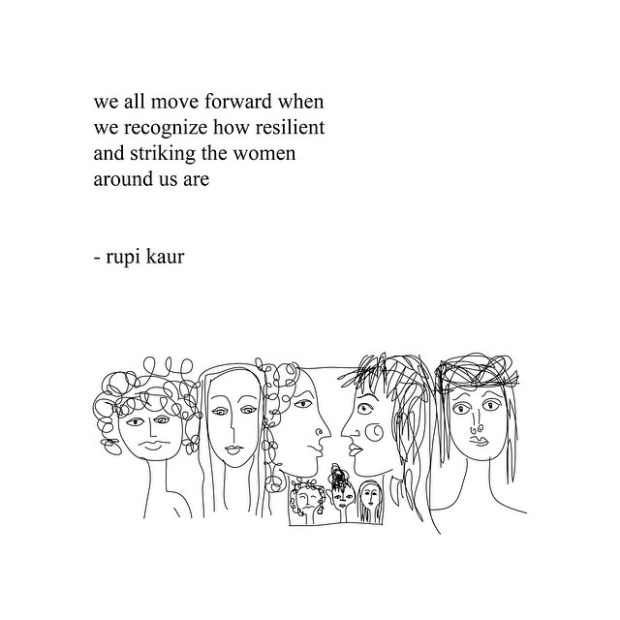
10727625_306202509574204_1165833578_n

From Rupi Kaur’s Milk and Honey


Poetry is quite ubiquitous, even if it is not actively sought out by most.

I was lucky enough to spend the past four days at the largest conference for women in technology in the world. The Grace Hopper Celebration is an acknowledgement of the incredible  work and research women in computing do all the time. It’s a networking event, a exhibition of talent and innovation, and most importantly a gathering of women in a field which repeatedly fails to include or promote women’s interests and which is lacking in women-led spaces. But what could a technical conference have to do with poetry? Among many incredible speakers and experiences at the 2018 Grace Hopper Celebration, was Amira Smith’s performance of “Solve for X”, a spoken word poem about her experience as a woman in technology, during the opening keynote of the conference. As part of the closing keynote, Heather Williams and Athena Rae performed “Advice to My Younger | Older Self”, a two-voice spoken word poem written by Micki LeSueur. I didn’t arrive at the event expecting to hear poetry, but it struck me more than ever as I watched these performances how powerful, communicative, and interdisciplinary poetry can be. I suspect that very few of the 18,000 attendees of this conference were poets, or possessed any academic inclination towards poetry, but I know that every one of us felt the message in these poems.

Poetry is often a medium for expressing passion. Reading, watching, or listening to poetry that resonates with your passion(s) is like being understood by another person on a very intimate level, which is why many people enjoy poetry that appeals to causes that they are affected by. Rupi Kaur, author of Milk and Honey, is an activist and feminist whose book has grown wildly popular because her audience relates to and believes in the things she writes. Poetry can be short and digestible, without losing the hard-hitting and genuine quality that comes with writing honestly and earnestly about real world problems. It is not a substitute for concrete information or education, it is an outlet to bring people with like experiences together.

The 2018 Grace Hopper Celebration was an incredible experience for me and I invite you to enjoy the poems I mentioned above as well as the rest of the long but inspiring keynotes if you so desire:


Solve for X by Amira Smith (starts at 1:27:05)


“Advice to My Younger | Older Self” by Micki LeSueur, performed by Heather Williams and Athena Rae (starts at 49:35)


Poetry in community


Why don’t more people read poetry for fun? There are a few suspect contributing factors.

I think many of us began linking poetry with negative connotations in school where we are often first exposed to one type of poetry. Usually we concentrate on ancient, white, male poets who write strictly organized narrative poetry with a rhyme scheme and about fifteen stanzas. Some of these, I don’t mind. My first favorite poet was Edgar Allan Poe, who falls face first into all the above categories. But it doesn’t give much scope for new readers to find what they enjoy, especially when so much of poetry is wildly different from that. The definition of poetry is so broad that finding something to your taste seems like it should be very doable. This may be the same reason that others find poetry intimidating; there is too much to explore, too much to examine. Dedicating time to it doesn’t feel valuable when there’s too much there to focus on one thing.

The breadth of the subject is also a reason as to why there is so much disagreement over what makes good poetry. Poetry is an intersection of wildly different audiences with wildly different opinions. Often, people will only have a taste for one category, genre, or era of poetry and have little interest in other poetry with less in common with what they know they enjoy. What is considered good in one style, by one audience, might be frowned upon in other contexts, and this is exaggerated by the wide difference in these styles. This leads to plenty of disagreement over what elements make good poetry; should it be personal? Detached? Romantic? Narrative? Rhythmic? Rhyming or free verse? I’ve even noticed that there is a gap in the quality of poetry which I can only assume is colored by perception. It tends to feel as if poetry is either very good or very bad, with very little middle ground. Evaluating poetry can be difficult and it’s hard to say whether this is a tendency for people to read anything that doesn’t immediately strike them as awful as being good, or anything that doesn’t immediately strike them as great as being terrible. I think it could be a little of both, depending on the person. Because poetry typically relies on rhythm, one usually forms a subconscious and very strong opinion on the sound, the syllable counts, and the enjambment, but doesn’t have a firm grasp on why they think what they do. Poetry sometimes just “feels” right or wrong.

Having so few metrics to judge the medium on instinctively and little consensus on what to explore (not to mention, a fairly small community to even point you in any direction at all), it’s no wonder more people don’t dwell on the subject. With a little more guidance and a nudge in the right direction, more people would probably find poetry they enjoy, but right now, they don’t even know what’s out there.

On that note, discover something new (maybe) below!

You do not have to be good.
You do not have to walk on your knees
for a hundred miles through the desert repenting.
You only have to let the soft animal of your body
love what it loves.
Tell me about despair, yours, and I will tell you mine.
Meanwhile the world goes on.
Meanwhile the sun and the clear pebbles of the rain
are moving across the landscapes,
over the prairies and the deep trees,
the mountains and the rivers.
Meanwhile the wild geese, high in the clean blue air,
are heading home again.
Whoever you are, no matter how lonely,
the world offers itself to your imagination,
calls to you like the wild geese, harsh and exciting –
over and over announcing your place
in the family of things.

Mary Oliver’s “Wild Geese”

and on a less classical note…

There are trees and they are on fire. There are hummingbirds and they are on fire. There are graves and they are on fire and the things coming out of the graves are on fire. The house you grew up in is on fire. There is a gigantic trebuchet on fire on the edge of a crater and the crater is on fire. There is a complex system of tunnels deep underneath the surface with only one entrance and one exit and the entire system is filled with fire. There is a wooden cage we’re trapped in, too large to see, and it is on fire. There are jaguars on fire. Wolves. Spiders. Wolf-spiders on fire. If there were people. If our fathers were alive. If we had a daughter. Fire to the edges. Fire in the river beds. Fire between the mattresses of the bed you were born in. Fire in your mother’s belly. There is a little boy wearing a fire shirt holding a baby lamb. There is a little girl in a fire skirt asking if she can ride the baby lamb like a horse. There is you on top of me with thighs of fire while a hot red fog hovers in your hair. There is me on top of you wearing a fire shirt and then pulling the fire shirt over my head and tossing it like a fireball through the fog at a new kind of dinosaur. There are meteorites disintegrating in the atmosphere just a few thousand feet above us and tiny fireballs are falling down around us, pooling around us, forming a kind of fire lake which then forms a kind of fire cloud. There is this feeling I get when I am with you. There is our future house burning like a star on the hill. There is our dark flickering shadow. There is my hand on fire in your hand on fire, my body on fire above your body on fire, our tongues made of ash. We are rocks on a distant and uninhabitable planet. We have our whole life ahead of us.

Zachary Schomburg’s “The Fire Cycle”

Starting with Szybist

There is something magnificent about reading poetry, as it is often meant to be read, in a collection. So often we are exposed only to “stand alone” poetry, cherry-picked by English teachers or sensationalized by media, and few are ever encouraged to pick up a full volume of the stuff to get the context of the piece.Getting to see these concepts explored across many pieces which come together to make a larger whole is a special and underrated part of appreciating poetry. I enjoy following motifs between different poems and watching similar vocabulary and enjambment choices that track movement throughout the collection. The first book of poetry I ever read was a piece called Incarnadine by Mary Szybist, and I read it in AP Literature my junior year of high school thanks to a teacher, Mr. Kleeman, with an enthusiasm for poetry. To this day, it’s one of my favorite books.

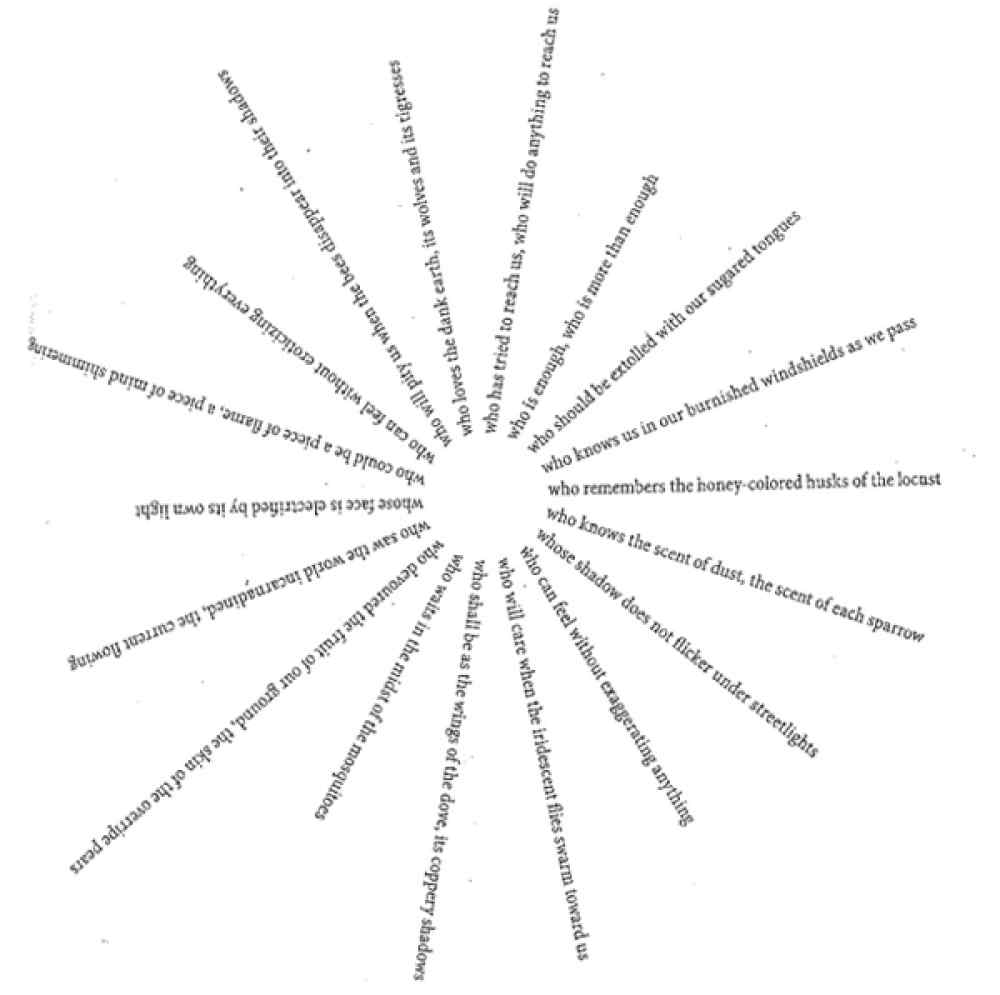
Poetry is generally published in a short book, all of the poems inside designed to be consumed together. A good book of poetry lets its contents play off of each other, continues ideas from one poem to another, and follows some kind of overarching theme which binds all the pieces together. In Incarnadine, Szybist uses biblical imagery and allusion to communicate ideas about her own life, feminism, and the world at large. She lingers in multiple pieces on the coincidental overlap of her own name with the Virgin Mary’s, letting that ambiguity resonate throughout her semi-biblical narrative. Though the source material suggests a conservative leaning, Szybist never seems to be constrained by her inspiration. In this book, she experiments with prose poetry (what’s on the box — poetry that looks like prose), concrete poetry (those are the ones that look like shapes), redaction poetry (take some source material and cross out words until it sounds pretty/means something), and many other creative and unique ways of expressing her theme. She uses biblical material to discuss modern ideas and confront modern issues, exemplifying the ways you can use vastly different ideas to communicate things about each other and find the similarities where you might think there are none.


Incarnadine blog image 4

A concrete poem: Mary Szybist’s “How (Not) to Talk of God”


The procession of new styles and techniques used in modern poetry and shown by Szybist and many other modern poets are a small window into the ongoing changes in poetic trends over time, particularly as exists within books and anthologies of poetry. I intend to continue this discussion over the course of this blog.


Mary Szybist is a National Book Award winning poet who teaches at Lewis & Clark College and has written two books (Incarnadine and Granted). I highly recommend reading more of her work!

It is so and so and not the dusty world
who drops.

It is their mother and not the dusty world
who drops them.

Why I imagine her so often
empty-handed

as houseboats’ distant lights
rise and fall on the far ripples—
I do not know.

I know that darkness.
Have stood on that bridge
in the space between the streetlights
dizzy with looking down.

Maybe some darks are deep enough to swallow
what we want them to.

But you can’t have two worlds in your hands
and choose emptiness.

I think that she will never sleep as I sleep,
I who have no so and so to throw

or mourn or to let go.

But in that once— with no more
mine, mine, this little so, and that one—

she is what

out-nights me.

So close. So-called

crazy little mother who does not jump.

A favorite: Mary Szybist’s “So-and-So Descending From the Bridge”