There is something magnificent about reading poetry, as it is often meant to be read, in a collection. So often we are exposed only to “stand alone” poetry, cherry-picked by English teachers or sensationalized by media, and few are ever encouraged to pick up a full volume of the stuff to get the context of the piece.Getting to see these concepts explored across many pieces which come together to make a larger whole is a special and underrated part of appreciating poetry. I enjoy following motifs between different poems and watching similar vocabulary and enjambment choices that track movement throughout the collection. The first book of poetry I ever read was a piece called Incarnadine by Mary Szybist, and I read it in AP Literature my junior year of high school thanks to a teacher, Mr. Kleeman, with an enthusiasm for poetry. To this day, it’s one of my favorite books.
Poetry is generally published in a short book, all of the poems inside designed to be consumed together. A good book of poetry lets its contents play off of each other, continues ideas from one poem to another, and follows some kind of overarching theme which binds all the pieces together. In Incarnadine, Szybist uses biblical imagery and allusion to communicate ideas about her own life, feminism, and the world at large. She lingers in multiple pieces on the coincidental overlap of her own name with the Virgin Mary’s, letting that ambiguity resonate throughout her semi-biblical narrative. Though the source material suggests a conservative leaning, Szybist never seems to be constrained by her inspiration. In this book, she experiments with prose poetry (what’s on the box — poetry that looks like prose), concrete poetry (those are the ones that look like shapes), redaction poetry (take some source material and cross out words until it sounds pretty/means something), and many other creative and unique ways of expressing her theme. She uses biblical material to discuss modern ideas and confront modern issues, exemplifying the ways you can use vastly different ideas to communicate things about each other and find the similarities where you might think there are none.
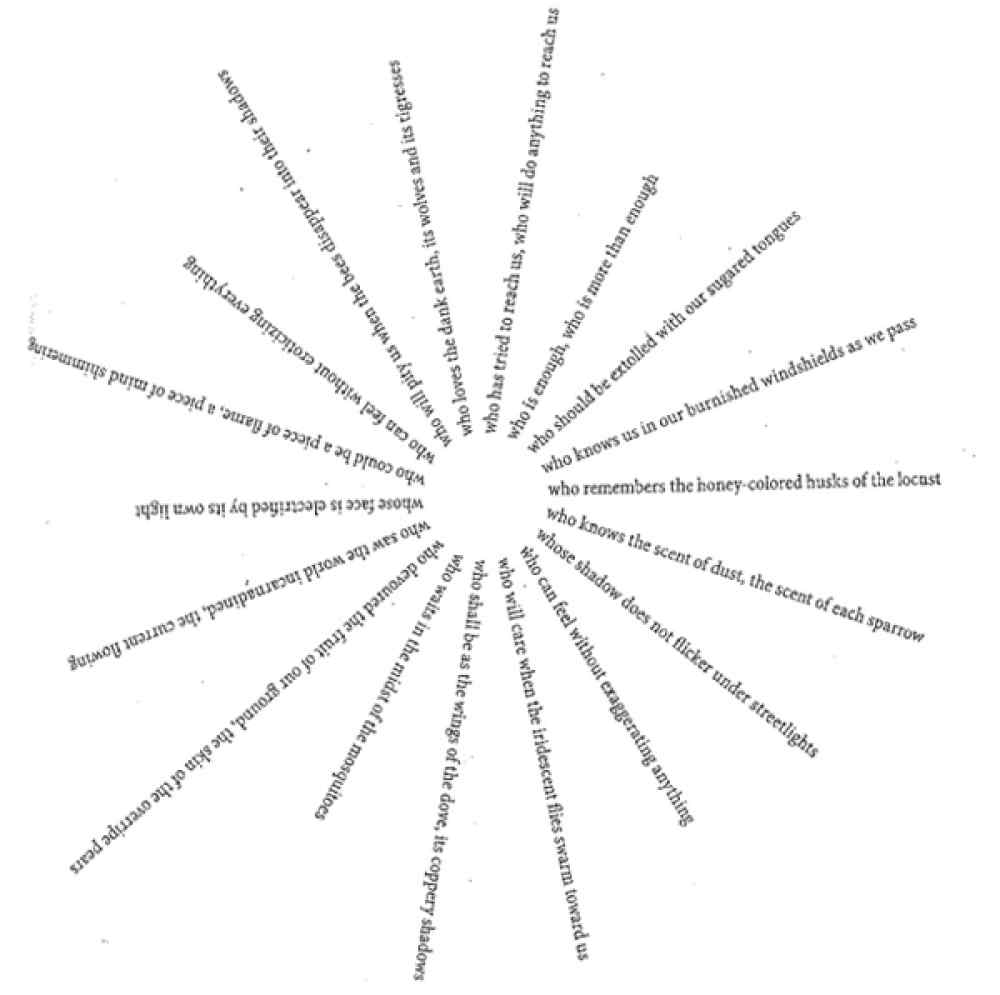
A concrete poem: Mary Szybist’s “How (Not) to Talk of God”
The procession of new styles and techniques used in modern poetry and shown by Szybist and many other modern poets are a small window into the ongoing changes in poetic trends over time, particularly as exists within books and anthologies of poetry. I intend to continue this discussion over the course of this blog.
Mary Szybist is a National Book Award winning poet who teaches at Lewis & Clark College and has written two books (Incarnadine and Granted). I highly recommend reading more of her work!
It is so and so and not the dusty world
who drops.It is their mother and not the dusty world
who drops them.Why I imagine her so often
empty-handedas houseboats’ distant lights
rise and fall on the far ripples—
I do not know.I know that darkness.
Have stood on that bridge
in the space between the streetlights
dizzy with looking down.Maybe some darks are deep enough to swallow
what we want them to.But you can’t have two worlds in your hands
and choose emptiness.I think that she will never sleep as I sleep,
I who have no so and so to throwor mourn or to let go.
But in that once— with no more
mine, mine, this little so, and that one—she is what
out-nights me.
So close. So-called
crazy little mother who does not jump.
- A favorite: Mary Szybist’s “So-and-So Descending From the Bridge”
 reasons for rhyme